What Is Digital Marketing? A Complete Beginner’s Guide
In today’s world, almost everyone uses the internet. People search on Google, watch videos on YouTube, scroll Instagram, and shop online. Because of this change, marketing has also changed. This new way of promoting products and services online is called Digital Marketing.
Internet marketing is one of the fastest-growing fields today. Students, job seekers, business owners, and freelancers are all interested in learning digital marketing. In this blog, we will understand what internet marketing is, how it works, its types, benefits, and career scope in very simple language.
What is Digital Marketing?
Internet marketing is the promotion of products, services, or brands through the internet and digital media.
Instead of using newspapers, TV, or billboards, digital marketing uses:
Websites
Search engines (Google, Bing)
Social media (Instagram, Facebook, YouTube)
Mobile apps
Example:
If you search “best mobile phone under 15000” on Google and see ads or blog posts, that is internet marketing.
Why Is Digital Marketing Important?
Digital marketing is significant because people spend most of their time online. Businesses want to reach customers where they are most active.
Main reasons why internet marketing is important:
It reaches more people at low cost
Small businesses can compete with big companies
Results can be tracked easily
Target audience can be selected (age, location, interest)
Fast growth and high demand for skills
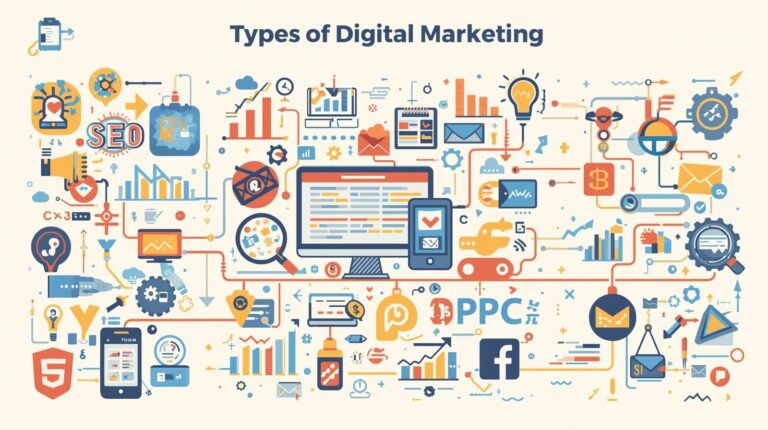
Types of Digital Marketing
There are many types of internet marketing. You do not need to learn everything at once. Let’s understand the main ones:
1. Search Engine Optimization (SEO)
SEO is the process of optimizing a website so that it appears on Google search results.
When a person searches something related to your website, SEO helps your website appear on top.
Example:
If your blog appears on Google for “What is internet marketing ?”, then it is SEO.
SEO comprises of:
Keyword research
On-page SEO
Off-page SEO
Technical SEO
2. Search Engine Marketing (SEM) / Google Ads
SEM is the paid marketing of search engines.
Companies pay Google to display ads on top of search engine results.
Example:
Google ads you see are SEM.
3. Social Media Marketing (SMM)
Social Media Marketing (SMM) refers to the process of promoting your content, brand, or products on social media sites like Instagram, Facebook, YouTube, and Twitter.
In SMM, social media marketers use various types of content to target and engage with their audience, such as:
Organic posts – These are free posts that are posted on the social media platform to engage with the audience and gain their trust.
Reels and Shorts – These are short videos that help your content go viral on social media platforms.
Paid Ads – These are sponsored ads that help you target a specific audience and gain faster results.
Social Media Marketing can help businesses increase their brand awareness, generate website traffic, and finally, generate leads or sales.
4. Content Marketing
Content marketing is making useful content to attract people.
Examples:
Blog posts
Videos
Infographics
Guides
Good content builds trust and brings long-term traffic.
Including blog posts videos guides articles tutorials ebooks resources
5. Email Marketing
Email marketing refers to the process of sending emails to users with the aim of promoting products, sharing offers, establishing relationships, boosting sales, creating leads, retaining customers, building loyalty, driving traffic, increasing engagement, and sending updates.
6. Affiliate Marketing
Affiliate marketing refers to the process of marketing other people’s products and earning commissions from sales.
Example: You share a product using a link. If a person buys the product, you get paid through online platforms, blogs, websites, videos, social media, and recommendations.
How Does Digital Marketing Work?
Internet marketing is a process that works in the following steps:
Understand the target audience
Select the right platform (Google, Instagram, YouTube)
Create quality content or ads
Drive traffic to website or page
Convert visitors into customers
Analyze results and improve
All this can be tracked with the help of Google Analytics.
Digital marketing has several benefits over traditional marketing.
Key benefits:
Low cost compared to TV and newspaper advertising
Global reach
Real-time tracking of performance
Improved targeting
High return on investment (ROI)
Digital Marketing for Beginners
If you are a beginner, don’t worry. You can start internet marketing step by step.
Beginner roadmap:
Learn basics of digital marketing
Start with SEO or social media
Practice on your own website
Use free tools
Create content regularly
Learn from mistakes
Consistency is more important than perfection.
Career Prospect in Digital Marketing (India)
Internet marketing has vast career prospects in India.
Common job titles:
SEO Executive
Internet Marketing Executive
Social Media Manager
Content Writer
PPC Specialist
Salary (approximate):
Freshers: ₹15,000 – ₹25,000 per month
With experience: ₹40,000 – ₹1,00,000+ per month
Freelancers can charge even higher based on their skills.
Who Can Learn Digital Marketing?
Anyone can learn digital marketing:
Students
12th pass candidates
College dropouts
Housewives
Business owners
No coding or advanced math skills are required in the initial stages and beginners can easily start with basic computer and internet knowledge.
Digital Marketing Tools (Basic)
Some of the tools that are commonly used:
Google Search Console
Keyword research tools
Email marketing tools
Social media scheduling tools
There are many tools that have free versions and help people learn and practice online.
Conclusion
The future of marketing is digital marketing. It is cheap, very effective, and full of opportunities. Whether you are looking for a job, freelancing, or you want to grow your business, digital marketing is a skill you should have.
Start small, learn more, and practice. With time, internet marketing can change your life.